
How to Search Civil Dockets
For a Twiggs County Superior civil action, the place to begin is Georgia Courts E-Access. Its Twiggs Superior row routes users to PeachCourt and flags that an account is required. After sign-in, pick Twiggs and Superior. Then run the exact case number. Vendor help also describes party-name searching where the authenticated interface offers it. Which office holds the record depends on the document. A Superior divorce, broad civil claim, or Superior order belongs with the Twiggs County Clerk of Superior Court. A limited claim, garnishment, trover, or listed personal-property matter may belong to Magistrate Court. Estates, wills, and guardianships go to Probate Court. The official clerk directory lists no Twiggs State Court entry.
- Copy the caption, court, case number, and party names from the source paper.
- Use E-Access and PeachCourt only when the paper names Twiggs Superior Court.
- Open the case information page and read filings in date order.
- Compare service, motions, orders, settings, disposition, and appeal entries.
- Contact the custodian for a missing image, full pleading, judgment, transcript, or certified copy.
Twiggs Civil Dockets via PeachCourt
PeachCourt wears two hats, and they are not the same. It handles e-filing, and it also serves as the routed public case provider. The PeachCourt access page covers login and registration. Its case-search help walks through the county, court, and case-number fields. A filing account submits papers. You do not need one just to read a Twiggs County civil docket. Open the register and identify each event before you buy an image. Provider terms list a $2 eAccess document charge. Document access costs $0.50 per page. A transaction convenience fee adds 3.5 percent plus $0.30, subject to current terms. Registration itself is free. So a docket search and paid image access are separate steps. Note: Confirm current PeachCourt charges before ordering. The vendor, not the Twiggs County clerk, publishes those online fees.
What a Civil Docket Shows
Uniform Superior Court Rule 39.2 spells out what a detailed civil register must hold. For Twiggs County, that means a civil docket can list quite a lot. You may see the action number and the cause of action. Party and attorney names can appear too. So can filing date, costs, service date and type, trial details, the final judge, and the disposition. The docket can also point you to related filings. Cross-references may cover pleadings and transcripts. Motions for new trial, appeals, remittitur, final records, and offsite storage may show up as well.
| Action number | The unique case identifier used for the docket and copy request. |
|---|---|
| Cause of action | The type of civil claim, not proof that the claim is true. |
| Service | The date and method used to give formal notice. |
| Motion and order | A request for a ruling and the separate judicial response. |
| Disposition | Dismissal, settlement, judgment, transfer, or administrative termination and its date. |
| Appeal record | Transcript, notice of appeal, and remittitur references when applicable. |
Read the full Twiggs County chronology before drawing conclusions. A complaint is not a judgment, and an answer does not decide the case.
Twiggs Civil Dockets at Magistrate
Twiggs County Magistrate Court handles civil disputes of $15,000 or less. Its official page also lists garnishments, civil suits, and trovers. It adds post-judgment interrogatories, abandonment of motor vehicles, and foreclosure of personal or rental property. The same page states there are no jury trials. Magistrate Court is not a court of record. That local limit explains many failed Superior searches. A Twiggs County Magistrate civil record does not move into PeachCourt just because both courts sit in the county. The court posts no public Twiggs Magistrate search form. Instead, call (478) 945-3428 or visit the office. Name the parties and filing, and ask how to inspect or obtain the specific record.
Types of Civil Cases on the Docket
Twiggs County Superior Court holds broad civil jurisdiction plus exclusive divorce jurisdiction. Contract, property, tort, family, and other actions within that authority can appear on its docket. Magistrate Court keeps its own limited civil claims. Probate Court maintains estates, wills, guardianships, and related proceedings. Each office keeps its own record stream.
| Matter | Start with | Access route |
|---|---|---|
| Superior civil action or divorce | Superior Clerk | E-Access to PeachCourt, then clerk |
| Claim of $15,000 or less | Magistrate Court | Phone or counter |
| Estate, will, guardianship | Probate Court | Probate office and its linked resources |
| Federal civil action | Middle District of Georgia | PACER, not PeachCourt |
A land, lien, UCC, or plat index on GSCCCA may relate to a dispute. Even so, it is not the Twiggs County civil case docket.
Twiggs Civil Docket Filing Sequence
The sequence helps a reader avoid false conclusions. A complaint or petition starts the matter, and service records formal notice. An answer responds. A motion asks the judge to act, while an order records the judge’s separate ruling. Later, a settlement, dismissal, transfer, trial, or judgment may appear. Any of these can close or redirect the action.
Civil docket flow: Filing › Service › Response › Motions and Orders › Hearing or Trial › Disposition
Later entries still matter. A final judgment may lead to a Fi.Fa., which is a writ connected with enforcement, or to an appeal. A remittitur marks the return from appellate review. Offsite-storage references simply tell the clerk where an older item is held, and they do not prove the item is gone.
Settings and Hearings on Civil Dockets
A Twiggs County civil docket can list motion hearings, calendar calls, and pretrial events. Trial dates and later proceedings may appear too. The Dublin Judicial Circuit calendar serves as a general guide for Superior Court scheduling. The circuit warns users to verify every date and time with the local clerk. A circuit-wide PDF may show a term or broad schedule without naming each case. Check the PeachCourt case events, the latest filed notice or order, and the full register. Then call the Superior clerk at (478) 945-3350. Keep in mind that a setting is not a disposition. A continuance postpones an event, and a reset assigns a new setting. Neither label means the civil claim has ended.
Twiggs Civil Filing Services
The GSCCCA filing-services page lays out eFile, eCertification, PT-61, and CourtTRAX side by side in their statewide roles.
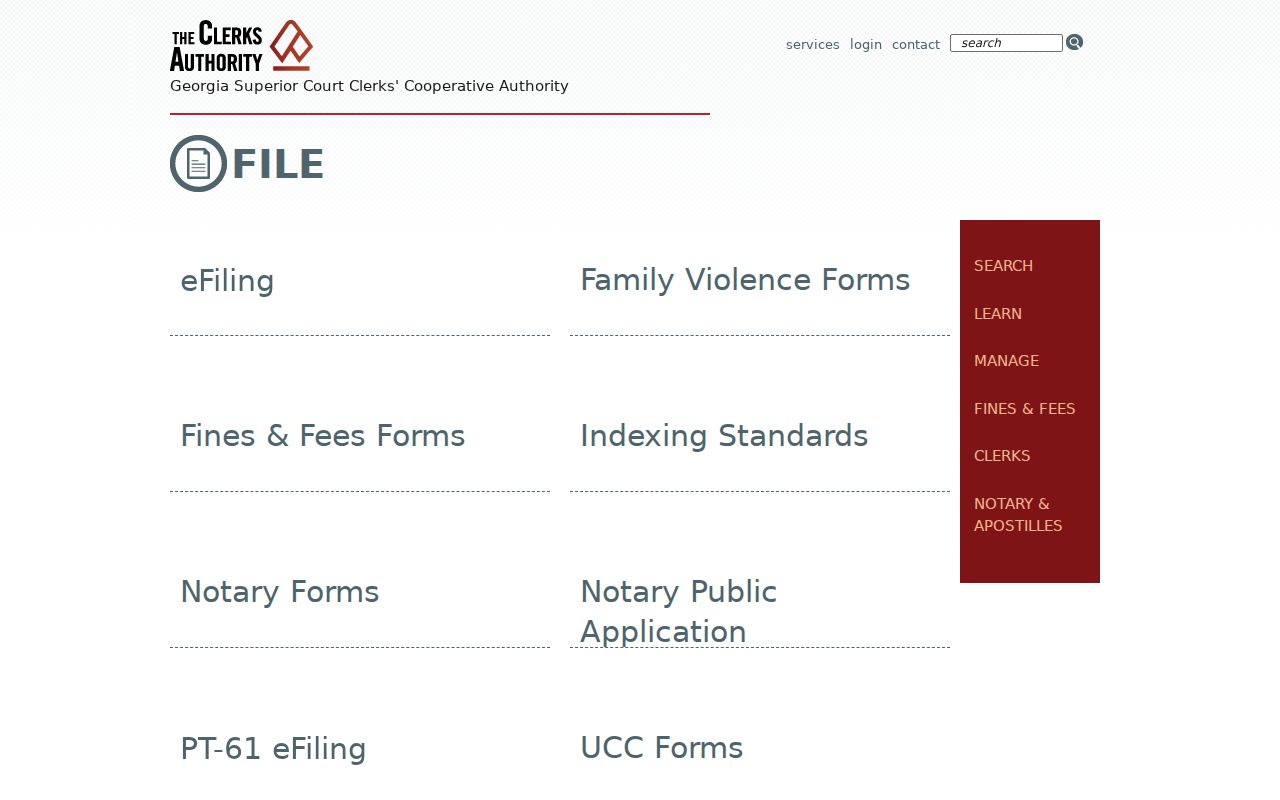
One point deserves repeating. GSCCCA searches do not substitute for PeachCourt's Superior case register. Nor do they replace the certified file held by the Twiggs County clerk. Each system covers a different slice of the civil docket. The Georgia Courts eFile chart shows Twiggs Superior on Peach Court mandatory status. Mandatory attorney e-filing still leaves gaps. Older images, sealed papers, and lower-court records may not sit online for public viewing at all.
Requesting Twiggs Civil Docket Records
A precise request gets results faster. Say exactly what you need from the Twiggs County civil docket: the register itself, a single pleading, an order, a final judgment, a transcript, or a certified copy. Add the court, the action number, the party caption, an approximate date, and your preferred format. A vendor's downloaded image is not a clerk-certified copy, so label it accordingly.
For Superior records, call (478) 945-3350 or fax (478) 945-6751. Ask about in-person inspection at 425 Railroad Street North. Magistrate civil matters go through (478) 945-3428. Probate civil matters use (478) 945-3390. Before mailing, faxing, or emailing a records request, let the office confirm its preferred method, cost, turnaround, and payment options. The county publishes no set civil-copy form or official local copy fee, so confirm those details with staff.
Public Access to Civil Dockets
Georgia rules start from openness. Superior Court records are presumed public unless a law or court order limits access. Uniform Rules 21 through 21.6 set the mechanics. They cover motions, hearings, the balancing test, temporary restrictions, review, and protected identifiers. Rule 39.6 goes further for adoptions. It makes those records and indexes confidential unless a judge orders otherwise. Family-related case records can hold restricted material too, even when a public docket entry exists.
Access rules: Uniform Superior Court Rules govern docket fields, sealing, redaction, and confidential adoption records. The Georgia Open Records Act sets a public-access presumption with exceptions and electronic access where practicable.
A missing docket image tells you nothing. The reason could be a seal, a redaction, offsite storage, an unscanned file, a request-only policy, or another court's jurisdiction over the record. Ask the Twiggs County clerk before assuming anything. Only a court order sets a legal limit; a broad web search decides nothing.